Sharif Osman bin Hadi
শরীফ ওসমান বিন হাদী
to
Political activist and organiser from Jhalokathi. He came to public prominence during the July 2024 uprising, co-founded Inqilab Moncho, and had announced an independent candidacy for Parliament in Dhaka-8 when he was shot in Dhaka in December 2025.
A sourced biography by Justice for Hadi, drawing on 14 published sources. Last reviewed . Skip to sources
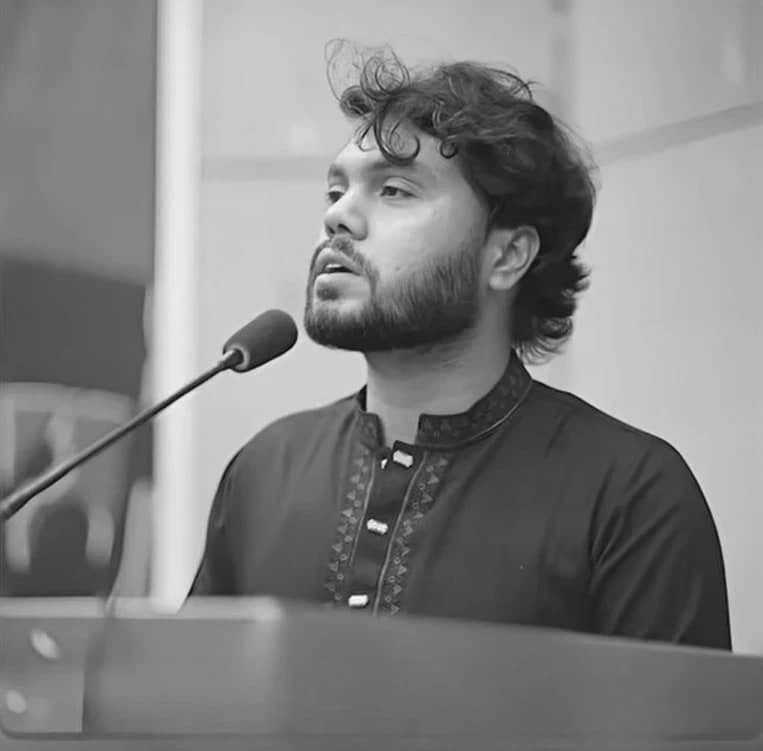
Who was Sharif Osman bin Hadi?
Sharif Osman bin Hadi was born on 30 June 1993 in Nalchity Upazila, in the southern district of Jhalokathi, the youngest of six children of a madrasa teacher. [1] He studied at a madrasa in Jhalakati and then at the University of Dhaka, where he read political science. [2, 3]
He came to national attention during the student-led uprising of July 2024, helping to organise demonstrations and acting, in one account, as a bridge between student groups and wider civil society. [4] After the fall of Sheikh Hasina’s government he co-founded Inqilab Moncho, a platform born of the protest movement, and became its spokesperson and convener. [1, 4]
By 2025 he was leading street protests, and he announced that he would stand as an independent candidate for Parliament in the Dhaka-8 constituency at the general election scheduled for February 2026. [1, 5, 4] On 12 December 2025 he was shot in central Dhaka after campaign activities there. He died in Singapore six days later, on 18 December, at the age of 32. [6, 7]
This page follows his life in order: his upbringing and education, the uprising, the politics he argued for, the threats he reported, his death and how he has been remembered. The investigation and court case that followed are documented separately in the Justice section.
At a glance
- Sharif Osman bin Hadi; also reported as Sharif Osman Hadi and Osman Hadi [1]
- 30 June 1993, Nalchity Upazila, Jhalokathi District [1]
- Youngest of six children. Father: Maulana Abdul Hadi, a madrasa teacher and local imam [1]
- Lecturer, Business Studies, University of Scholars, Dhaka (briefly) [1]
- Announced as an independent candidate for Dhaka-8 at the election scheduled for February 2026 [5, 4]
- 18 December 2025, Singapore General Hospital, aged 32 [7]
- 20 December 2025, University of Dhaka campus, beside Kazi Nazrul Islam [8]
Early life in Jhalokathi
- Born in Nalchity Upazila, Jhalokathi
Hadi was born on 30 June 1993 in Nalchity Upazila of Jhalokathi District, in the south of Bangladesh. He was the youngest of six children. [1]
His father, Maulana Abdul Hadi, taught at a madrasa and served as a local imam. [1] Accounts of Hadi’s early years describe a devout household in which religious learning and education were central. [1, 2]
Little else about his childhood is recorded in the sources the project holds. No family recollections, school records or photographs from these years have yet been collected with permission, so none are shown here.
From madrasa to Dhaka University
- Enrols at the University of Dhaka
- Publishes a collection of poetry under a pen name
He was educated at Jhalakati N. S. Kamil Madrasa, where he completed the Alim, the higher-secondary certificate of the madrasa system. [2]
In 2010 he enrolled at the University of Dhaka to study political science, and went on to complete a master’s degree in the subject. At university he became active in campus politics and in debating, where, according to a published profile, he developed as a speaker and an organiser. [3]
After graduating he worked for a short time as a lecturer in the Business Studies department of the University of Scholars, a private university in Dhaka. [1] He also wrote poetry, and in 2024 published a collection under a pen name. [1, 3]
By the time of the uprising, then, his public life had already begun: years of campus politics, debating and teaching lay behind the organiser who would become known across the country in 2024.
The details in this chapter rest mainly on reference compilations rather than on primary records. The title of the poetry collection, the pen name and the years of his degrees are not given in the sources held, and will be added only once verified.
July 2024: The uprising that made him a public figure
- Student protests begin over the job quota system
- Sheikh Hasina’s government falls
In July 2024, students across Bangladesh took to the streets against a government quota system for public-sector jobs that favoured descendants of veterans of the 1971 war. The protests grew into a broader movement against the government of Prime Minister Sheikh Hasina, and security forces responded with a deadly crackdown. [5] In August 2024 her government fell, ending fifteen years in power, and she left the country for India. [9, 10]
Hadi was a Dhaka University graduate in his early thirties when the protests began. [10] He helped organise demonstrations and, in CNA’s account, acted as a bridge between student groups and wider civil society, communicating the students’ demands for reform. [4] From his neighbourhood of Rampura in Dhaka he coordinated local protest activity and rallies. [1]
He spoke out against Hasina’s government, which he called “fascist”, and demanded justice for the protesters who had been killed. In the Financial Express’s account, this outspokenness earned him a reputation as one of the most prominent voices of the movement. [2] Reports describe him as a coordinator among those who came to be known as the “July Warriors”. [6, 10]
The uprising changed his standing. Writing after his death, commentators placed him among a new generation of activists unaligned with the established parties, noting that he rejected allegiance to both the Awami League, Hasina’s party, and the main opposition party, the BNP. [10]
After July: Inqilab Moncho
In the aftermath of the uprising Hadi co-founded Inqilab Moncho, a name rendered in English as “Platform for Revolution”: a youth-led socio-political platform that grew out of the protest movement. [1, 4] He served as its spokesperson and convener. [1]
As Hadi set them out, the platform’s aims were to defend Bangladesh’s independence and sovereignty, to secure accountability for the killing of unarmed protesters, and to introduce reforms that would prevent a return to authoritarian rule. [1]
Inqilab Moncho worked alongside other youth and civil-society groups, sometimes referred to as the “July Unity” coalition, in pressing for justice for the July killings. Their demands included a constitutional ban on the Awami League over its alleged role in atrocities. [1]
Hadi led rallies calling for the trial of those responsible for killing protesters and for the Awami League to be barred from future elections. At a “martyrs’ assembly” at Shahbagh in Dhaka he issued an ultimatum: if the demands were not met within 100 days, a “March for Bangladesh” would set out towards the national Secretariat. [1]
Through 2025 he remained on the streets, leading protests that urged the government to outlaw the Awami League formally. Under his leadership Inqilab Moncho also campaigned against what it called “Indian hegemony” in Bangladesh’s affairs. [1]
Political ideas and public positions
The positions below are Hadi’s own, or Inqilab Moncho’s, as they were reported. They are set out to explain his politics, not as findings of this project.
Justice for July
From the uprising onwards he demanded justice for the protesters who had been killed, and accountability for their deaths was one of Inqilab Moncho’s stated aims. [2, 1] He described Sheikh Hasina’s government as “fascist” and “autocratic”, and portrayed it as having betrayed the country’s democratic ideals. [2]
The Awami League
He campaigned for the Awami League to be banned and barred from future elections, a demand he and Inqilab Moncho’s allies tied to the party’s alleged role in atrocities. [1]
India and sovereignty
Criticism of India was a constant in his politics. He alleged that India had propped up Hasina’s government for fifteen years, and he opposed political groups he regarded as aligned with New Delhi’s interests. [2, 5] In an Inqilab Moncho statement he described the struggle as one against “Indian hegemony”, which he presented as neo-colonial interference. [5]
The established parties and the interim government
His criticism was not confined to the Awami League. He accused the BNP, and the interim government, of “failing to free themselves from Indian control”. [2]
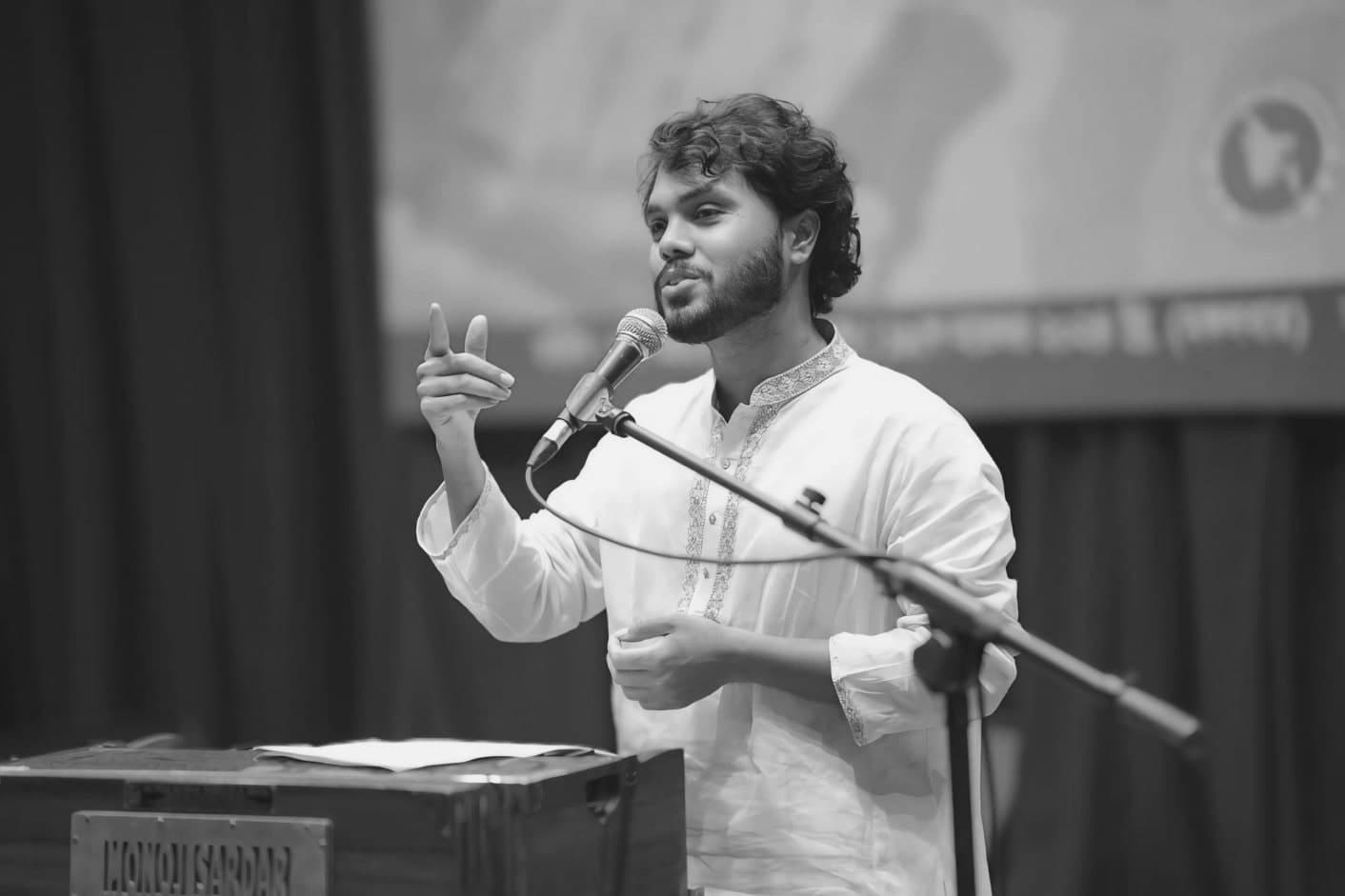
Faith and the language of sacrifice
His public statements drew on religious language and on the idea of martyrdom. His post about the threats against him in November 2025, quoted in chapter 8, invoked God, prayed for “a martyr’s death with a smile” and declared that “Allah will create countless Hadis on this land”. [11]
A new Bangladesh
By late 2025 his rallies were organised around his call for “a new Bangladesh free from domination”. [12]
How he was seen
The descriptions of Hadi published around the time of his death differ sharply depending on who was speaking. This project adopts none of them. Words such as “martyr”, “hero” or “radical” appear on this page only as quotations, attributed to the people who used them.
Supporters
Political allies spoke of integrity and courage. Mia Golam Parwar, secretary general of Jamaat-e-Islami, said Hadi had lived a “clean, honest and principled life” that inspired people across the country, and called him an “undaunted revolutionary fighter of July”. [12] The interim government’s chief adviser, Muhammad Yunus, called him a “fearless fighter”. [4]
Critics
In parts of the Indian press he was presented very differently. Indian outlets often described him as a “radical” youth leader because of his stance on India; the Deccan Chronicle’s profile was headlined “Who was Bangladeshi Radical Leader, Sharif Osman Hadi?”. [6] The Financial Express profile called him an “anti-India student leader”. [2]
The project’s research compilation also refers to wider domestic criticism of Hadi and of Inqilab Moncho, and to Hadi’s own rejection of the “radical” label, but does not tie either to a source. Both are omitted until they can be sourced.
From the street to the ballot: Dhaka-8
- General election scheduled
Hadi announced that he would stand for Parliament as an independent candidate in the Dhaka-8 constituency (the Bijoynagar area) at the general election scheduled for February 2026. [5, 4]
Standing as an independent was consistent with his refusal to align with either of the established parties. Jacobin described the candidacy as a direct challenge to the entrenched political order. [10]
By December 2025 he was campaigning in the constituency. On Friday 12 December, after Jumu’ah prayers, he spoke at a mosque and handed out leaflets in the Paltan and Bijoynagar area. [11, 6]
He did not live to contest the election.
Threats and the final months
- Says publicly he has received death threats
In November 2025 Hadi said publicly that he had received dozens of death threats, many of them, he said, from foreign phone numbers. He attributed the threats to Awami League loyalists. [11] This page records his account and his attribution as his own statements; it does not establish who sent the threats.
“I am under constant surveillance. They said they will … kill me … Even if … I am burned alive, I will not move an inch from this struggle for justice, God willing.”
In the same post he wrote that he prayed for “a martyr’s death with a smile”, and that if he were killed, “Allah will create countless Hadis on this land … This angry voice of freedom can never be silenced.” [11]
He continued to campaign. In December he was handing out leaflets in Dhaka-8. [11]
12 December 2025
Box Culvert Road, Dhaka
This chapter describes the shooting of Hadi in plain terms. It contains no images.
On Friday 12 December 2025, after campaigning in the Paltan and Bijoynagar area, Hadi left in a battery-powered auto-rickshaw. [11, 6] At about 2:25 p.m., on Box Culvert Road, he was shot in the head by attackers who then escaped into the traffic, according to police and eyewitness accounts. [6, 11, 5]
Six days
Taken to Dhaka Medical College Hospital within minutes of the shooting. Doctors find a critical brain injury, and he is placed in intensive care on life support. [2]
- Between 12 and 15 December
Moved to Evercare Hospital in Dhaka for critical care. [6]
Flown to Singapore General Hospital for specialist neurosurgical care. [7]
Dies at Singapore General Hospital, having remained in a coma without regaining consciousness. [8, 7]
The investigation into the shooting, and the court proceedings that followed, are recorded in the Justice section rather than here.
18 December 2025
Singapore
Sharif Osman bin Hadi died at Singapore General Hospital on 18 December 2025. He was 32 years old. [7]
“Despite the best efforts of the doctors from SGH and the National Neuroscience Institute, Mr Hadi succumbed to his injuries on 18 December 2025.”
The nation mourned
- His body is returned to Dhaka
- State mourning, funeral prayer and burial
News of his death brought thousands of people, most of them students, onto the streets of Dhaka in the early hours of 19 December. Many gathered at Shahbagh, demanding the arrest of his killers. [9, 5] Some carried banners asking “Who Killed Hadi?”. [10]
Some of the protests turned violent. That night the Dhaka offices of the newspapers Prothom Alo and The Daily Star were attacked and set on fire, and journalists were trapped inside until they were rescued. By 19 December unrest had spread to other cities. [5, 9, 10] Human Rights Watch, which condemned Hadi’s killing, also condemned the attacks on the press. [8]
In a televised address the chief adviser, Muhammad Yunus, called Hadi’s death “an irreparable loss for the nation” and said that “the country’s march towards democracy cannot be halted through fear, terror, or bloodshed.” [5] The interim government declared a day of state mourning for Saturday 20 December, with the national flag at half-mast on government and educational buildings and special prayers at mosques, temples, churches and pagodas. [4]
His body arrived at Hazrat Shahjalal International Airport in Dhaka at about 6:05 p.m. on 19 December, and thousands of people lined the airport road. [13]
On 20 December his funeral prayer, the namaz-e-janaza, was held on Manik Mia Avenue in front of the National Parliament. [13] It was attended by Yunus, President Mohammed Shahabuddin, the military chiefs and representatives of almost every political party. Reuters described it as one of the largest funerals in recent Bangladeshi history. [8]
“Today, we have come to promise you, Hadi, that we will fulfill what you stood for.”
He was buried on the University of Dhaka campus, beside the grave of the national poet Kazi Nazrul Islam, an honour Reuters described as rare. [8]
Condolences came from across the political spectrum. The acting chairman of the BNP said, “We are deeply saddened by the death of Sharif Osman Hadi … this is a great loss”, and the National Citizen Party and student organisations issued statements of mourning. [5] From abroad, the UN High Commissioner for Human Rights, Volker Türk, urged “a prompt, impartial, thorough and transparent investigation into the attack that led to Hadi’s death”, [9] and the US Embassy and the British High Commission in Dhaka issued messages of condolence. [14, 13]
Legacy
How Hadi is remembered is still being shaped. This chapter separates what has been documented, acts of commemoration and public statements, from interpretations of what his life and death mean.
Acts of remembrance
The state marked his death with a day of mourning, a funeral prayer attended by the country’s leadership, and burial beside Kazi Nazrul Islam on the University of Dhaka campus. [4, 8] The interim government also directed that his widow and young daughter be taken under the state’s care. [4]
Memorial gatherings continued after the funeral. At a memorial prayer reported by BSS, Mia Golam Parwar of Jamaat-e-Islami called the funeral a historic tribute and claimed that “millions of people” had attended it. Hadi’s elder brother, Omar bin Hadi, also spoke at a memorial. [12]
“My brother has attained martyrdom. Now it is our collective responsibility to fulfill the dream he cherished and to complete his unfinished revolution.”
In the words of supporters and officials
Inqilab Moncho announced his death on Facebook with the words: “In the struggle against Indian hegemony, Allah has accepted the great revolutionary Osman Hadi as a martyr.” [5] Muhammad Yunus called him an “immortal soldier in the struggle against fascism and hegemony” and urged the country’s young people to carry his vision forward. [4]
Murals, vigils and the circulation of his speeches online are mentioned in the project’s research compilation without sources, and are not described here until they are documented. A collection of his speeches and writings, each traced to a recording or an original publication with its Bangla text, is being prepared for the Speeches & Ideas section.
An unresolved demand
Within hours of his death, supporters were demanding the arrest and punishment of those who killed him. [5, 9] Where that demand stands today, and what the investigation and the courts have and have not established, is recorded with its sources in the Justice section.
Interpretations
What his life and death mean for Bangladesh remains contested. Analysts quoted at the time warned that his killing, and the violence that followed it, could deepen political divisions or disrupt the election. [5, 6] His supporters, and the interim government in its statements, presented him instead as a figure whose ideals the country should carry forward. [4, 12]
What can be documented is narrower than any of these claims: a life of thirty-two years, the positions he argued for in public, the threats he reported, and the ways in which people have chosen to remember him. This biography will be revised as that record is verified.
A life in dates
The main dates of his life, as the sources record them. Open markers show dates that are approximate or not yet confirmed.
Born in Nalchity Upazila, Jhalokathi [1]
- Date not confirmed
Completes the Alim at Jhalakati N. S. Kamil Madrasa [2]
Enrols at the University of Dhaka to study political science [3]
Helps organise demonstrations during the July uprising [4]
Sheikh Hasina’s government falls [5]
- After August 2024
- By late 2025
Says publicly that he has received death threats [11]
Shot on Box Culvert Road, Dhaka [6]
Flown to Singapore General Hospital [7]
Dies at Singapore General Hospital, aged 32 [7]
His body is returned to Dhaka [13]
Funeral prayer on Manik Mia Avenue [13]; buried beside Kazi Nazrul Islam [8]
Sources and notes
This biography was compiled by Justice for Hadi from published news reports, news profiles and an official statement, gathered in the project’s research document “Sharif Osman Hadi: A Comprehensive Biography”. Each numbered citation in the text points to the publication the statement rests on.
None of these sources has yet been through the project’s formal verification process. Most are independent news reports or profiles; one is a statement by Singapore’s Ministry of Foreign Affairs. Two are reference compilations, which the project treats as leads rather than evidence; the details that rest mainly on them, chiefly his early life and education, are marked in the text.
Statements by Hadi, by his supporters and by his critics are reported as their statements. Allegations are not presented as established facts, and nothing on this page concerns the guilt of any person.
Last reviewed . To report an error, see corrections; for how the project works, see the research methodology.
Sources
- 1Osman Hadi
Wikipedia · Reference compilation · en.wikipedia.org
Reference compilation: treated as a lead to be verified against primary records, not as evidence on its own.
↩ First cited in “Introduction” - 2Who was Sharif Osman Hadi? Anti-India student leader’s death sparks violent protests in Bangladesh
The Financial Express · 19 December 2025 · News profile · financialexpress.com
Source catalogue record and provenance
↩ First cited in “Introduction” - 3Sharif Osman Hadi Died, Shot, Age, Education & Biography
Hamariweb · Reference compilation · hamariweb.com
Reference compilation: treated as a lead to be verified against primary records, not as evidence on its own.
↩ First cited in “Introduction” - 4Who is Sharif Osman Hadi, the youth leader whose assassination sparked protests in Bangladesh?
CNA · 19 December 2025 · News profile · channelnewsasia.com
Source catalogue record and provenance
↩ First cited in “Introduction” - 5Who was Sharif Osman Hadi; why is Bangladesh on fire over his death?
Al Jazeera · 19 December 2025 · News profile · aljazeera.com
Source catalogue record and provenance
↩ First cited in “Introduction” - 6Who was Bangladeshi Radical Leader, Sharif Osman Hadi?
Deccan Chronicle · News profile · deccanchronicle.com
Source catalogue record and provenance
↩ First cited in “Introduction” - 7MFA Spokesperson’s Comments on the Death of Mr Sharif Osman Hadi, 18 December 2025
Ministry of Foreign Affairs, Singapore · 18 December 2025 · Official statement · mfa.gov.sg
Source catalogue record and provenance
↩ First cited in “Introduction” - 8Bangladesh holds state funeral for slain youth leader amid tight security
Reuters · 20 December 2025 · News report · reuters.com
News archive record and context
Source catalogue record and provenance
↩ First cited in “At a glance” - 9Violent protests in Bangladesh after pro-democracy figure dies in hospital
The Guardian · 19 December 2025 · News report · theguardian.com
Source catalogue record and provenance
↩ First cited in “July 2024” - 10The Uprisings in Bangladesh Will Not Be Stopped
Jacobin · 24 December 2025 · Analysis · jacobin.com
Source catalogue record and provenance
↩ First cited in “July 2024” - 11Hadi ‘received death threats from foreign numbers’
bdnews24.com · 12 December 2025 · News report · bdnews24.com
Source catalogue record and provenance
↩ First cited in “Ideas and positions” - 12Osman Hadi’s clean life, courage inspired the nation: Parwar
BSS · 21 December 2025 · News report · bssnews.net
Source catalogue record and provenance
↩ First cited in “Ideas and positions” - 13US, UK express deep sorrow over Osman Hadi’s death
The Business Standard · News report · tbsnews.net
Source catalogue record and provenance
↩ First cited in “Mourning” - 14US Embassy mourns death of Sharif Osman Hadi
BSS · News report · bssnews.net
Source catalogue record and provenance
↩ First cited in “Mourning”
Omitted and conflicting details
- State mourning
- CNA reports a one-day state mourning on 20 December 2025, which this page follows. Another passage of the project’s research compilation refers to “half-day” mourning without a source; that discrepancy is unresolved.
- The funeral prayer
- The Business Standard places the namaz-e-janaza on Manik Mia Avenue in front of the National Parliament. The research compilation, citing Reuters, also describes tens of thousands joining a prayer in the University of Dhaka’s central grounds. This page gives the Manik Mia Avenue location and no crowd figure until the accounts are reconciled.
- Hadi’s November 2025 post
- His line about “countless Hadis” appears in two English wordings in the research compilation. This page uses the wording reported by bdnews24.com. The Bangla original of the post has not yet been archived, and the exact date of the post is not given in the sources held.
- The attack
- Accounts differ on the number of attackers and vehicles involved. Those details, and everything concerning suspects and the investigation, belong to the case record in the Justice section.
- Dates not yet confirmed
- The sources held do not give the date he moved to Evercare Hospital, the founding date of Inqilab Moncho, the date of the Shahbagh ultimatum, the date he announced his candidacy, or the title of his poetry collection and his pen name. Older project records give exact times for the hospital transfers and his death, and a founding date for Inqilab Moncho, without sources; they are not used.
- Unsourced material omitted
- Characterisations in the research compilation that carry no source are left out: comparisons with earlier national figures, descriptions of his popularity and personal finances, references to murals, vigils and viral speeches, and a quotation from an unnamed television commentator. His mother’s name, which appears in older project data without a source, is also omitted.
- The July uprising
- Casualty figures for the uprising are not given on this page. The July archive will set them out with their sources and attribution.
Photographs
The two photographs on this page are working copies held by the project. Their photographers, dates, places and reuse rights have not yet been documented. They are shown in monochrome, without any other alteration, and will be credited or replaced once their provenance is established.